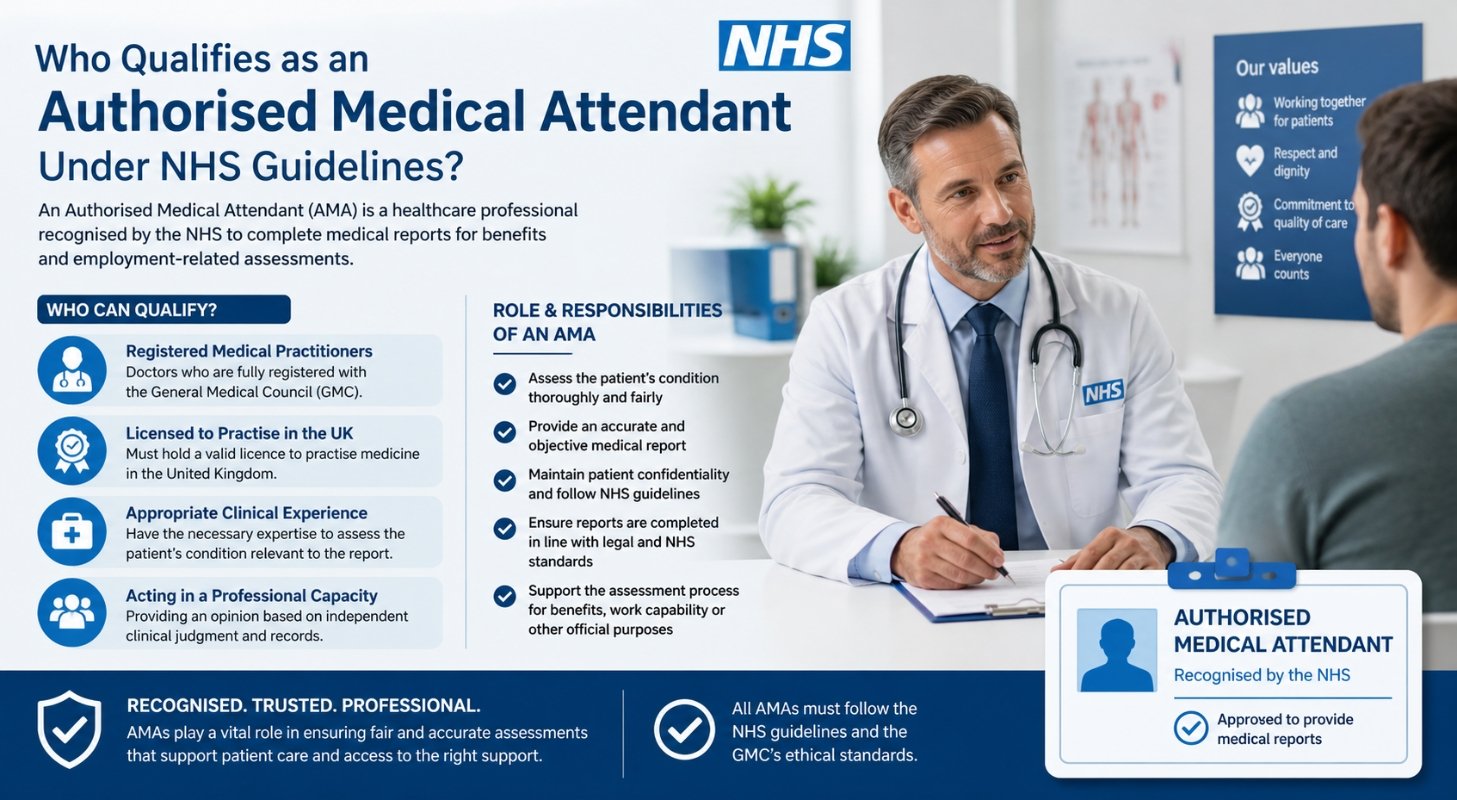
When it comes to healthcare provision in the United Kingdom, titles and roles carry enormous weight. Whether you are navigating workplace health policies, planning for medical travel assistance, or simply trying to understand who holds legitimate authority in a clinical or occupational setting, the term Authorised Medical Attendant appears with increasing regularity. Yet for many people, including those working within the health sector itself, the precise definition of who qualifies under this designation remains surprisingly unclear.
This article sets out to explain, in plain and practical terms, exactly who qualifies as an Authorised Medical Attendant under NHS guidelines, what responsibilities that role entails, and why the distinction matters so profoundly in both private and public healthcare settings across England, Scotland, Wales, and Northern Ireland.
Understanding the Term Authorised Medical Attendant
The phrase Authorised Medical Attendant, often abbreviated to AMA, refers to a qualified healthcare professional who has been formally recognised and authorised to provide medical care, supervision, or certification in a specific context. The term is not used loosely. It carries formal implications, particularly when it appears in employment contracts, insurance documentation, aviation medicine, occupational health frameworks, and NHS-linked services.
Within the NHS framework, an Authorised Medical Attendant is typically a registered medical practitioner, though the scope of who qualifies has expanded over the years as advanced nurse practitioners, paramedics, and specialist allied health professionals have taken on increasingly complex clinical responsibilities. The key word here is “authorised.” It implies not just a professional qualification, but an explicit recognition by a governing body, employer, or regulatory authority that the individual is competent to perform specific duties in a defined setting.
The Core Criteria for Qualification
For someone to qualify as an Authorised Medical Attendant under NHS guidelines, several core criteria must generally be met. These are not arbitrary requirements. Each one exists to protect patients, ensure accountability, and maintain the integrity of medical decisions.
Registration with a Recognised Regulatory Body
First and foremost, any individual seeking AMA status must be registered with an appropriate regulatory body in the United Kingdom. For doctors, this means registration with the General Medical Council (GMC). For nurses and midwives, it is the Nursing and Midwifery Council (NMC). Paramedics are registered with the Health and Care Professions Council (HCPC), as are a wide range of other allied health professionals including physiotherapists, radiographers, and occupational therapists.
Without active registration in good standing, no individual, regardless of their experience or clinical knowledge, can legitimately hold the title of Authorised Medical Attendant. Registration must be current, not lapsed, and must not carry any fitness to practise restrictions that would limit the scope of the individual’s clinical activities.
Relevant Clinical Competence
Registration alone is not sufficient. The individual must also demonstrate relevant clinical competence for the specific context in which they are being authorised. An Authorised Medical Attendant overseeing an airline passenger with a complex condition, for instance, requires a different skill set from one providing occupational health clearance in an industrial workplace.
NHS guidelines emphasise the importance of ongoing professional development and revalidation. A doctor must revalidate with the GMC every five years, demonstrating that they continue to meet the standards expected of their profession. Nurses undergo similar processes through the NMC’s revalidation requirements. This ongoing commitment to competence is not merely a bureaucratic formality. It ensures that anyone acting as an Authorised Medical Attendant has genuinely kept pace with developments in clinical practice.
Employer or Institutional Authorisation
Beyond professional registration and clinical competence, the “authorised” aspect of the title typically requires explicit recognition from an employer, institution, or government body. In an NHS context, this might mean that a Trust has formally designated certain medical staff as authorised to carry out specific functions such as issuing medical certificates, overseeing patient transport, or providing fitness-to-work assessments.
In the aviation sector, Civil Aviation Authority (CAA) approved Aviation Medical Examiners often hold de facto AMA status when accompanying patients on medical flights. In occupational health, a company doctor or nurse appointed through a formal process and contracted to assess employee fitness would similarly qualify.
The Range of Professionals Who May Qualify
One of the more nuanced aspects of the Authorised Medical Attendant designation is that it is not confined to doctors alone. The NHS, as it has evolved into a multidisciplinary system, has created pathways for a broader range of qualified professionals to fulfil this role depending on the context.
General Practitioners and Hospital Physicians
The most traditional form of Authorised Medical Attendant is the qualified and registered doctor, whether a GP working in the community or a hospital consultant. GPs in particular are frequently asked to act as an authorised attendant when patients require medical certification, travel clearance, or pre-employment health assessment. Their broad clinical knowledge and existing relationship with patients makes them well suited to this role.
Advanced Nurse Practitioners
In recent years, Advanced Nurse Practitioners (ANPs) have taken on a significantly expanded scope of practice within the NHS. Many ANPs now possess the training and authority to prescribe medication, make diagnoses, and provide clinical assessments that were previously the exclusive domain of doctors. In certain healthcare trusts and occupational settings, suitably qualified ANPs may be formally designated as Authorised Medical Attendants, particularly where their scope of practice aligns with the duties required.
Paramedics and Extended Practice Clinicians
Specialist and advanced paramedics, particularly those working in critical care or urgent care settings, may also qualify under the AMA framework in specific operational contexts. For example, a Specialist Paramedic accompanying a patient during a high-dependency transfer may hold AMA status for the purposes of that journey. The HCPC registration and demonstrated competence remain the qualifying threshold.
Occupational Health Physicians and Nurses
Occupational health is a setting where the Authorised Medical Attendant title appears with particular frequency. Occupational health physicians are often employed or contracted by organisations to make formal decisions about an employee’s fitness to work, their capacity to undertake certain tasks, or their eligibility for ill-health retirement. These roles require both clinical expertise and a specific understanding of occupational health legislation, making them a distinct specialism within the AMA framework.
Common Settings Where the AMA Role Applies
Understanding who qualifies is made clearer when one considers the contexts in which the designation is actually applied.
Medical Travel and Patient Repatriation
When patients need to travel by air or road over long distances due to their medical condition, an Authorised Medical Attendant is frequently required to accompany them. This person is responsible for monitoring the patient’s condition during transit, administering any necessary medications, and making clinical decisions if the patient’s condition changes. Airlines and medical repatriation services have strict criteria for who qualifies to fulfil this role, and insurers routinely require documentation confirming AMA status before approving such arrangements.
Workplace and Occupational Health
Employers across the UK are required by law to ensure their workforces are medically fit to perform certain roles. This is particularly true in sectors such as transport, construction, emergency services, and healthcare itself. An Authorised Medical Attendant in this context may be a contracted occupational physician or nurse who conducts health surveillance, pre-employment medicals, and periodic assessments to ensure compliance with statutory requirements.
NHS Primary and Secondary Care Settings
Within the NHS itself, the concept of an authorised medical attendant underpins the hierarchy of clinical responsibility. When a patient is referred from primary to secondary care, when medications are prescribed, or when a patient is certified as unfit for work, the clinical professional doing so is acting in an authorised capacity. The NHS Constitution and associated clinical governance frameworks make clear that such authority is granted through registration, training, and formal appointment, not simply through self-declaration.
The Importance of the Designation in Everyday Healthcare
It might be tempting to view the Authorised Medical Attendant designation as a bureaucratic label relevant only in niche or specialist circumstances. In reality, however, understanding who holds this status touches the daily experiences of millions of people receiving care across the UK.
Consider, for example, a person managing a chronic condition at home. They may rely on a range of healthcare products to monitor and maintain their health between appointments. Devices such as the GlucoFix Tech GK dual glucose and ketone monitor allow patients to track vital metabolic markers from home, empowering them to make informed decisions between clinical reviews. The role of an authorised clinician in interpreting such results and guiding treatment decisions remains central, even when the patient is largely self-managing.
Similarly, during episodes of acute illness such as the cold and flu season, people across the UK reach for trusted remedies like Lemsip Max Cold and Flu to manage their symptoms. Whilst over-the-counter products play a valuable role in symptom relief, an Authorised Medical Attendant remains the appropriate person to advise when symptoms become severe, persistent, or indicative of a more serious underlying condition.
For families with young children, products like Bonjela Junior Gel provide targeted relief for teething discomfort and mouth ulcers. Again, whilst such products are available without prescription, the guidance of a qualified medical attendant becomes essential when a child’s symptoms fall outside the expected pattern or when parents have concerns about underlying health issues.
During the winter months particularly, many people also rely on products such as Night Nurse Capsules to manage cold and flu symptoms overnight. The authorised clinician, whether a GP, pharmacist, or advanced nurse practitioner, plays a vital role in advising on appropriate use, particularly for patients who may be taking other medications or who have underlying health conditions that affect which treatments are suitable.
The Role of Community Pharmacies in Supporting AMA Functions
It would be remiss to discuss the Authorised Medical Attendant framework without acknowledging the increasingly significant role that community pharmacists play within it. NHS England and the devolved health authorities have, in recent years, extended the formal responsibilities of pharmacists in ways that bring them closer to the AMA designation in specific contexts.
Pharmacists, particularly those working as clinical pharmacists within GP practices or as independent prescribers in community settings, now carry out many of the functions traditionally associated with authorised medical attendants. They conduct medicines reviews, initiate and modify prescriptions, provide clinical advice on minor ailments, and make referrals when necessary.
For patients seeking accessible healthcare support, services offered through trusted providers such as YourChemist demonstrate how community pharmacy continues to evolve as a frontline healthcare resource. Similarly, for those in the north of England looking for accessible clinical support, understanding the landscape of pharmacies in Manchester can be an important step in knowing where to find authorised clinical guidance close to home.
What Happens If Someone Acts Without Proper Authorisation
The importance of the AMA qualification becomes starkly apparent when one considers the consequences of someone providing medical attendant services without the appropriate credentials. Acting as a medical attendant without registration, without institutional authorisation, or without the requisite competence is not simply a professional failing. It carries serious legal consequences.
Under the Medical Act 1983 and associated legislation, it is a criminal offence to wilfully and falsely pretend to be a registered medical practitioner. Individuals who falsely claim AMA status in order to accompany patients on medical flights, provide occupational health clearance, or issue medical certificates may face prosecution, civil liability for any harm caused, and referral to professional regulators. Employers who knowingly appoint unqualified individuals to these roles face similar exposure.
How to Verify AMA Status
If you are an employer, an insurer, an airline, or a patient or their family member needing to confirm that a proposed Authorised Medical Attendant genuinely qualifies, verification is straightforward. All GMC-registered doctors can be verified through the GMC’s online register. NMC-registered nurses and midwives can be checked through the NMC register, and HCPC-registered professionals through the HCPC’s online tool. These registers are publicly accessible and are updated in real time to reflect any changes in registration status, including conditions, suspensions, or erasures.
In occupational and travel medicine contexts, professional bodies such as the Faculty of Occupational Medicine and the Aerospace Medical Association provide additional frameworks for verifying specialist credentials. Requesting documentation of these credentials before accepting someone in an AMA role is not only reasonable but advisable.
Conclusion
The question of who qualifies as an Authorised Medical Attendant under NHS guidelines is one that deserves a clear and thorough answer, precisely because the consequences of getting it wrong can be serious for patients, employers, and clinicians alike. In summary, qualification rests on three pillars: current registration with an appropriate UK regulatory body, demonstrated clinical competence relevant to the specific context, and formal authorisation from an employer, institution, or governing authority.
The role is not limited to doctors alone. Advanced nurse practitioners, specialist paramedics, occupational health professionals, and in certain circumstances, clinical pharmacists, may all qualify depending on the setting and the nature of the duties involved. What unites all legitimate Authorised Medical Attendants is a genuine commitment to patient safety, professional accountability, and the standards of care that the NHS and its associated regulatory frameworks rightly demand.
For patients, understanding this framework helps them make informed decisions about the care they receive and the professionals they trust. For clinicians and employers, it provides a clear set of standards against which responsibility and competence can be measured and upheld.