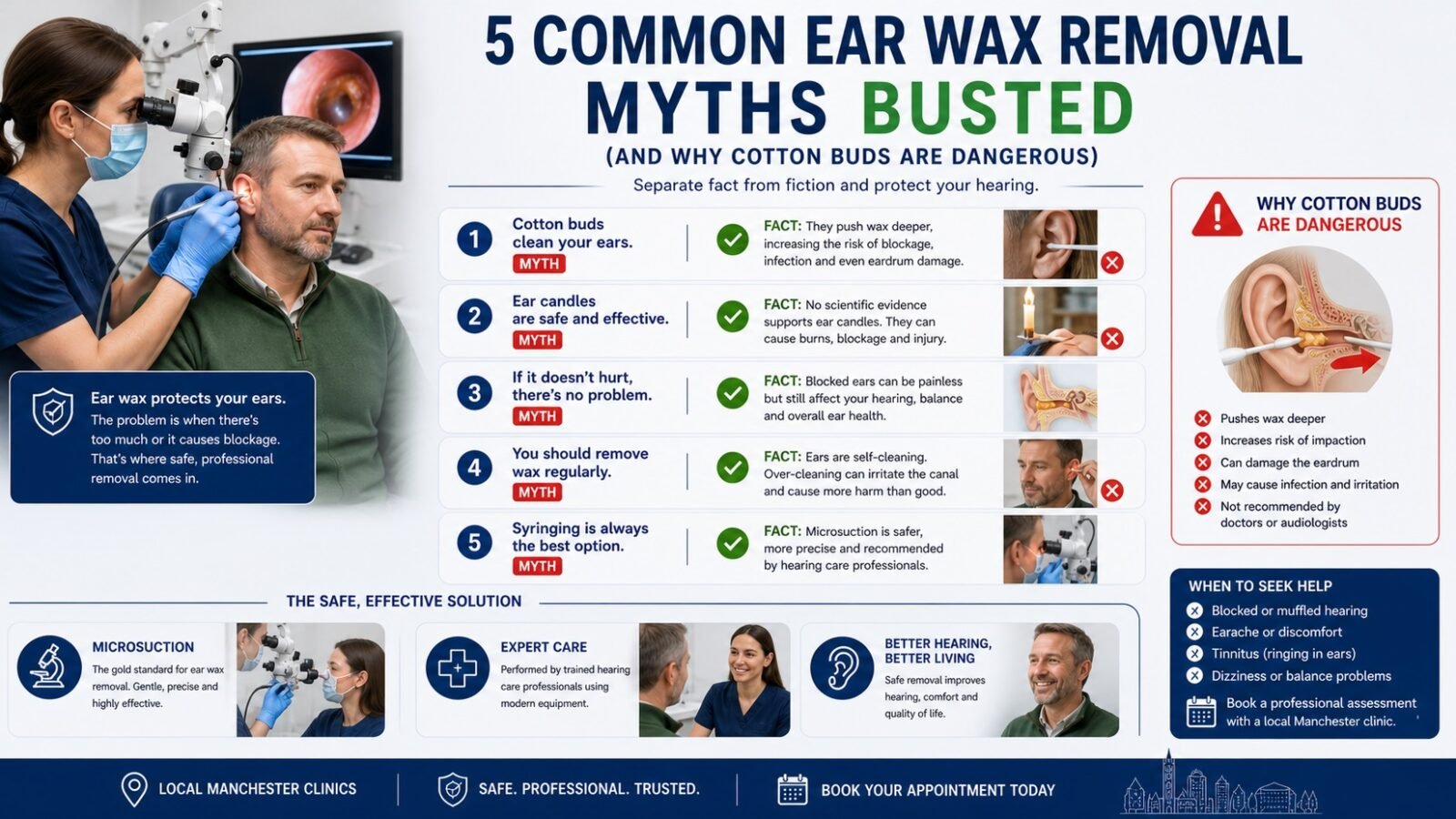
Few areas of everyday health are surrounded by as much misinformation as ear care. From childhood advice passed down through generations to confidently delivered tips on social media, the volume of dubious wisdom about ears is genuinely staggering. Some of it is harmless, the kind of folk knowledge that might be wrong but does no real damage. Other bits, though, can cause genuine harm, and a surprising number of people in Manchester end up at clinics every year because they have followed advice that sounded sensible but turned out to be anything but.
This article picks apart five of the most stubborn myths about ear wax and ear cleaning, and explains why one particular product, the humble cotton bud, deserves a much worse reputation than it has. The aim is not to lecture anyone but to clear up some genuine confusion that affects people’s everyday choices. Once you know what is actually going on inside your ears, looking after them becomes much simpler.
Myth One: Ear Wax is Dirty and Should Be Removed
The first and possibly most damaging myth is the idea that ear wax is somehow unclean, embarrassing, or a sign of poor hygiene. Generations of people have grown up thinking that the goal of personal grooming is to keep the ears completely free of wax, that visible wax means you have not washed properly, and that any sign of build up should be dealt with immediately. This thinking is comprehensively wrong on every count.
Ear wax is produced deliberately by glands in the outer part of the ear canal, and it serves several genuinely useful purposes. It traps dust, dead skin cells, and small debris before they can reach the delicate eardrum. It contains antimicrobial compounds that slow the growth of bacteria and fungi. It moisturises the canal skin and prevents it from drying out and cracking. And, crucially, it migrates outwards naturally, carrying with it the trapped debris and old skin cells, in a self cleaning mechanism that has been refined over millions of years of evolution.
People with completely wax free ears are not cleaner than the rest of us. They tend, in fact, to suffer more from itchy ears, dry skin in the canal, and minor infections, because the protective layer their ears should be producing has been stripped away. A healthy ear has wax in it. The presence of wax is a sign that things are working properly, not a problem that needs fixing.
Myth Two: You Can Safely Clean Your Ears with Cotton Buds
Cotton buds, also called cotton swabs in some places, occupy a strange position in modern bathrooms. They are sold as a beauty and grooming product, the packaging often suggests they are for general hygiene, and almost every household in Manchester has a packet sitting somewhere. Yet the manufacturers themselves often print warnings on the box telling you not to insert them into the ear canal. The instructions are routinely ignored, and the consequences fill clinic appointment books across the city.
The fundamental problem with cotton buds is that they are slightly wider than the typical ear canal opening but narrower than the canal itself. When you push one in, you are not removing wax. You are pushing most of it deeper into the canal, where it gets compacted against the eardrum into a hard plug that the body cannot then clear naturally. The small amount of wax that does come out on the cotton tip creates the illusion of effective cleaning, but the much larger amount being driven inwards is invisible to you.
Beyond compaction, cotton buds carry several other risks. The thin skin of the canal can be scratched or torn, leading to infections that can take weeks to clear. The eardrum itself can be perforated if the bud is pushed too far, particularly by someone with a longer canal than they realise. Foreign body injuries, where the cotton tip detaches and remains lodged in the canal, are surprisingly common and require professional removal. And the simple act of stimulating the canal with a cotton bud can encourage the glands to produce more wax, creating a cycle of perceived dirtiness that drives even more cotton bud use.
Myth Three: Ear Candles Are a Natural Alternative
Ear candling, sometimes called thermo auricular therapy, is a procedure that involves placing a hollow candle into the ear and lighting the other end. The theory, promoted by various wellness practitioners, is that the warmth and gentle suction created by the burning candle draws wax and toxins out of the ear. After the procedure, the candle is opened up to reveal what looks like a substantial brown deposit, presented as proof that the treatment has worked.
The science here is unambiguous. The brown deposit inside the candle is simply the residue of the candle wax itself, produced regardless of whether the candle has been used near an ear or not. Studies that have compared candles burned in ears with candles burned in mid air have found no difference in the amount of debris produced. Beyond being ineffective, ear candling carries genuine risks. Burns to the face, ear, and canal are well documented. Hot wax dripping into the canal can cause serious damage, including burns to the eardrum that may require surgical intervention.
Reputable practitioners and regulatory bodies have repeatedly warned against the practice, and any clinic in Manchester that offers it as a serious treatment for wax build up should be regarded with significant suspicion. There are perfectly good ways to remove wax safely and effectively, and ear candles are not among them.
Myth Four: If You Have a Lot of Wax, You Are Producing Too Much
Another common misconception is that build up of wax means your body is producing too much of it, and that the goal of treatment is somehow to slow down or suppress production. While individual variation in wax production certainly exists, most people who experience problematic build up are not producing abnormal amounts. The issue is usually with how the wax is being managed once it has been produced.
Several factors disrupt the natural outward migration of wax. Wearing hearing aids or earbuds for long periods physically blocks the canal, preventing wax from leaving and pushing existing wax further in. Cotton bud use, as already discussed, has the same effect. Anatomical factors such as a narrow or twisty canal can mean that wax struggles to make its way out under any circumstances. Age can change the consistency of wax, making it drier and harder to migrate. And certain skin conditions can affect the canal’s ability to manage wax in the usual way.
Understanding this matters because it shapes the right approach to prevention. Trying to suppress wax production is futile and arguably counterproductive, since the wax serves an important purpose. The better strategy is to support the natural process where you can. Avoid pushing things into your ears, give your ears occasional breaks from earbuds and hearing aids where possible, use olive oil drops occasionally to keep the wax soft, and seek professional removal when build up does occur. The aim is not to have permanently bone dry ears but to keep things in healthy balance.
Myth Five: Hot Water in the Shower Cleans Your Ears
The idea that letting hot water run into your ears in the shower somehow cleans them is widespread but worth examining carefully. There is a grain of truth here. Mild exposure to water during normal showering does help to soften wax and can support its natural outward migration, particularly when combined with the gentle drying action of a clean towel afterwards. However, the more confident version of this myth, which suggests that you should deliberately direct water flow into the canal or hold your head under the showerhead to flush them out, is genuinely problematic.
Driving water into the canal can have similar effects to syringing without any of the controls that make a clinical procedure safe. The temperature is uncertain, the pressure is uncontrolled, and the angle of entry is essentially random. Water trapped behind hardened wax becomes a breeding ground for the bacteria and fungi that cause swimmer’s ear, a painful infection of the canal skin that can take a long time to clear. People who deliberately use the shower to clean their ears often find themselves dealing with the very problems they were trying to avoid.
If you do want to support your ears with water, the gentlest approach is best. Let the regular water that runs over your ears during a normal shower do its work without trying to direct extra flow inwards. Tilt your head briefly to each side to let any water that has entered the canal run out naturally, and dry the outer ear with a soft towel. That is genuinely all the cleaning a healthy ear needs from your daily routine.
Why Cotton Buds Deserve a Special Mention
Of all the myths and habits discussed here, cotton bud use stands out as the most widespread and the most damaging. It is genuinely worth taking seriously because, despite all the warnings, the average bathroom in Manchester still has a pack of buds within easy reach and the average person reaches for them several times a week. The habit is so ingrained that breaking it can feel surprisingly difficult, even after the dangers have been explained.
The clinical evidence against cotton bud use in the ear canal is overwhelming. Manchester audiologists routinely see patients whose impacted wax has been caused or worsened by cotton bud use, patients with scratched canal skin, patients with perforated eardrums, and patients with foreign body injuries from detached cotton tips. None of this happens to most users, of course, but the cumulative cost across the population is significant. Switching to using cotton buds only on the outer fold of the ear, where they pose no real danger, is one of the simplest and most useful changes anyone can make for their hearing health.
What Healthy Ear Care Actually Looks Like
Stripped of all the myths, looking after your ears is genuinely simple. Leave them alone most of the time. Trust the body’s natural process to do its job. Use a soft towel to dry the outer ear after showering. If you wear hearing aids or earbuds frequently, give your ears occasional breaks. If you feel build up developing, use olive oil drops for a few days and see if the issue resolves. If it does not, or if you experience pain, hearing loss, or discharge, book a professional appointment.
This approach is far less effortful than the elaborate cleaning rituals many people inflict on their ears, and it produces much better outcomes. Healthy ears are quiet, comfortable, and require very little active management. Once you stop trying to fight against the body’s own systems and start working with them instead, ear problems become considerably less common, less troublesome, and less expensive to deal with.