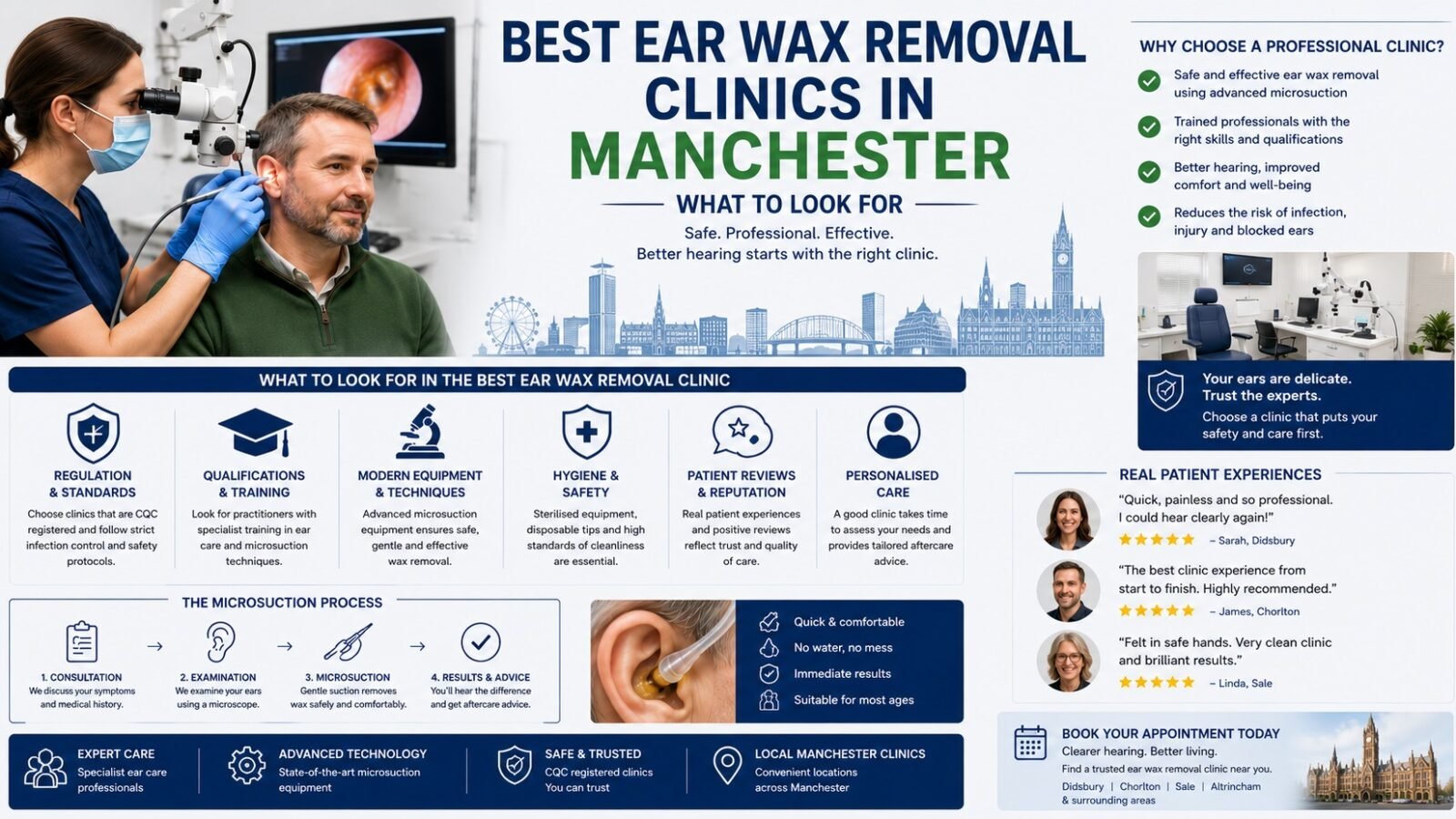
Choosing where to go for ear wax removal in Manchester is, on the surface, a simple decision. A quick online search throws up dozens of options across the city, prices that look broadly similar, and websites that all seem to promise a friendly, professional, gold standard service. Scratch beneath that surface, though, and you find that the quality of clinics varies considerably more than the marketing language suggests. Some are genuinely excellent, run by experienced clinicians using top end equipment in well appointed premises. Others are barely qualified outfits that have spotted a market opportunity and are providing care to a standard that should worry anyone paying attention.
Knowing how to tell the two apart is one of the more useful pieces of practical knowledge a Manchester resident can have. Your ears are not the place to economise badly, and a poor experience with the wrong clinic can produce outcomes ranging from incomplete removal that leaves you no better off than you were, to genuine injury that takes weeks to recover from. This article walks through the things that genuinely matter when choosing a clinic, from the qualifications of the practitioner to the quality of the equipment, and gives you a practical framework for making a sensible decision.
The Importance of Practitioner Qualifications
The single most important factor in clinic quality is the person actually carrying out the procedure. Microsuction is not something that anyone can do safely after a weekend course, despite the impression you might get from some training providers. A properly qualified ear care practitioner has typically completed a substantial training programme, gained supervised clinical experience, and continues to undergo professional development throughout their career.
The qualifications worth looking for include registration with the Health and Care Professions Council, which covers most audiologists practising in the United Kingdom. The Academy for Healthcare Science maintains a register of clinical practitioners who have demonstrated specific competencies in ear care. The British Society of Audiology offers continuing professional development for its members, and clinicians who are active members tend to be those who take their work seriously. The British Society of Hearing Aid Audiologists is another credible organisation whose members include many qualified ear care providers.
You should be able to find these credentials clearly displayed on a clinic’s website, and any reputable provider will be happy to confirm them by email or phone if you ask. If a clinic is vague about its practitioners’ qualifications, lists only generic certificates from training providers you have never heard of, or relies heavily on phrases like fully trained without specifying by whom, treat that as a warning sign and look elsewhere.
Equipment Standards
The equipment a clinic uses tells you a great deal about how seriously it takes the work. Proper microsuction requires either a binocular operating microscope or a high quality endoscope to give the practitioner direct vision into the canal throughout the procedure. The suction unit itself should be a medical grade device with adjustable pressure, not a basic pump bought to keep costs down. Single use sterile suction tips and instruments are the standard expectation, not optional extras.
Video otoscopy, where you can see your own ear canal on a screen before and after the procedure, has become increasingly common at better clinics across Manchester. This is not just a gimmick. It allows the practitioner to show you what they are dealing with, document the appearance of your ears for future reference, and confirm that the procedure has achieved what it set out to achieve. Clinics that have invested in this equipment generally take other aspects of their work equally seriously.
The premises themselves matter to a lesser extent but still tell you something. A clinic that operates from a clean, professional space with proper hand washing facilities, appropriate lighting, and well maintained equipment is making the kind of investment that suggests they are in the business for the long term. Pop up operations in shared spaces, garage extensions, or settings that feel more like a salon than a clinic should give you pause, even if the price looks attractive.
Reading Reviews Properly
Online reviews are an obvious resource, but they need to be read with some care. The most useful reviews are detailed, mention the practitioner by name, describe the experience step by step, and feel like they were written by a real patient rather than a marketing exercise. A clinic with hundreds of glowing five star reviews that all sound similar and were posted within a short timeframe should be approached cautiously. A clinic with a smaller number of detailed, varied, mostly positive reviews from over a longer period is likely to be giving you a more accurate picture of what to expect.
Pay particular attention to negative reviews, but read them critically. A reasonable clinic will have the occasional unhappy patient, because this is true of every service business. What matters is whether the clinic responds to negative feedback professionally, whether the complaints follow a pattern, and whether the issues raised are minor inconveniences or serious concerns about the quality of care. A handful of complaints about parking or appointment timing is not the same as repeated reports of incomplete removal, dismissive practitioners, or pressure to buy hearing aids.
Independent platforms such as Google Reviews, Trustpilot, and the more medically focused review sites tend to be more reliable than testimonials hosted on the clinic’s own website. Personal recommendations from friends, family, or colleagues who have used a particular clinic are often the most valuable source of all, since they come from people you trust and can be questioned in detail.
Insurance and Professional Indemnity
Any clinic carrying out ear wax removal should have appropriate professional indemnity insurance. This protects both the practitioner and the patient in the unlikely event that something goes wrong, and it is also a sign that the practitioner is operating professionally rather than informally. Insurance providers generally only cover practitioners who can demonstrate proper qualifications and follow recognised standards of practice, so the existence of professional cover is a useful indirect indicator of quality.
You should not need to ask about insurance directly in most cases, because reputable clinics will mention their professional standing on their website. If you do want to confirm, a polite enquiry to the clinic should produce a clear answer. Anyone who becomes evasive or dismissive in response to such a question is telling you something useful about their approach to their work.
The Initial Phone or Email Enquiry
Long before you visit a clinic, you can learn quite a bit about it from how it responds to an initial enquiry. A reputable clinic will answer the phone within reasonable hours, respond to emails within a day or two, give you clear and honest answers to questions about price, qualifications, and procedures, and not pressure you into booking before you are ready. The person who answers the phone may be a receptionist or the practitioner themselves, but in either case they should be friendly, professional, and willing to take the time to address your concerns.
Be wary of clinics that pressure you into booking on the call, offer mysterious special prices that expire if you do not commit immediately, or steer the conversation aggressively towards services you have not asked about. The ear care market in Manchester is competitive, and reputable providers know that earning your trust is a better long term strategy than pushing you into a decision. A clinic that treats your initial enquiry with respect is likely to treat the appointment itself the same way.
Location and Practical Considerations
For most people, the practical considerations of where a clinic is and how easy it is to get to do matter, particularly if you anticipate needing more than one appointment. A clinic that is convenient to your home, your workplace, or your usual route around Manchester is easier to use regularly than one that requires a special journey. Parking, public transport access, accessibility for wheelchair users or those with mobility difficulties, and the availability of evening or weekend appointments are all worth thinking about.
That said, you should not let convenience override the more important factors. A genuinely excellent clinic that requires a slightly longer journey is almost always a better choice than a mediocre one round the corner. The procedure does not happen often enough for travel time to be a major issue for most people, and the difference in care quality can be significant.
Specialist vs General Provision
Manchester has a mix of clinics that specialise specifically in ear care and others that offer ear wax removal as part of a broader service. Both can be excellent, but they tend to have different strengths. Dedicated ear care clinics often have practitioners who do nothing else and have therefore built up enormous experience with unusual cases, complications, and the full range of patient needs. Their equipment is typically optimised for ear work, and their approach tends to be highly focused.
Hearing aid clinics that offer ear care alongside their main business often have very competent practitioners and good equipment, particularly if they are run by registered audiologists. The advantage of this kind of clinic is that they have a holistic view of hearing health, which can be useful if there is anything else going on with your ears beyond simple wax build up. The potential disadvantage, occasionally, is that some such clinics use ear care as a route to selling hearing aids, which can lead to gentle pressure that you should be aware of.
Optician based clinics have also expanded into ear care over recent years, and the standard of these varies. Some offer genuinely competent service, particularly the larger chains that have invested in proper training and equipment for their staff. Others should be approached with more care, since the staff training in some cases is more limited than the marketing suggests. Reading reviews and asking about specific qualifications is particularly important with this category.
Red Flags to Watch For
Several specific signs should make you reconsider a clinic before booking. Practitioners whose only qualification is a brief private course, particularly one delivered in a single day, are unlikely to have the depth of training needed to handle anything beyond the most straightforward cases. Clinics that perform ear candling, which has no clinical evidence base, alongside their other services suggest a willingness to offer treatments that lack proper grounding. Premises that look unprofessional, equipment that looks cheap or dated, or practitioners who do not wear appropriate clinical attire are all small but meaningful indicators.
Pricing that is dramatically lower than the market average can be a warning sign rather than a bargain. Sustainable ear care practice involves real costs in equipment, premises, training, and insurance, and clinics that undercut the market significantly are usually doing so by skimping on at least one of these. Conversely, very high prices are not automatically a sign of quality, particularly if the clinic cannot articulate clearly what extra value the additional cost is buying you.
Aggressive upselling, whether of hearing aids, additional services, or premium tier appointments, suggests a commercial focus that may not align with your interests as a patient. A reputable practitioner will recommend further services only when they are clinically warranted and will respect your decision to decline.
Building a Long Term Relationship
Once you have found a clinic you trust, sticking with it tends to pay dividends. The practitioner gets to know your ears, builds up a record of your history, can spot subtle changes that might warrant attention, and develops a genuine professional relationship with you over time. This continuity is itself a form of quality care, and it is worth a small premium over hopping between cheaper alternatives based purely on whoever has the best deal at the moment.
Manchester is fortunate to have a strong cohort of excellent ear care providers, and finding the right one for you is genuinely possible with a bit of careful research. Take the time to make a thoughtful choice, ask the questions that matter, and trust your instincts when something feels off. Your hearing is too valuable to leave to chance, and the right clinic will look after it for years to come.